Annual Reviews
This information is for parents/carers of children and young people with education, health and care plans (EHCPs). You can download this page as a PDF document if you wish to view offline.
Watch the video for an explanation produced by the Council for Disabled Children.
This page will explain
- The annual review process – before, during and after
- Which sections of the EHCP matter most
- How to ask for change of placement
- What to do if you’re not happy with an amended EHCP
What is an annual review?
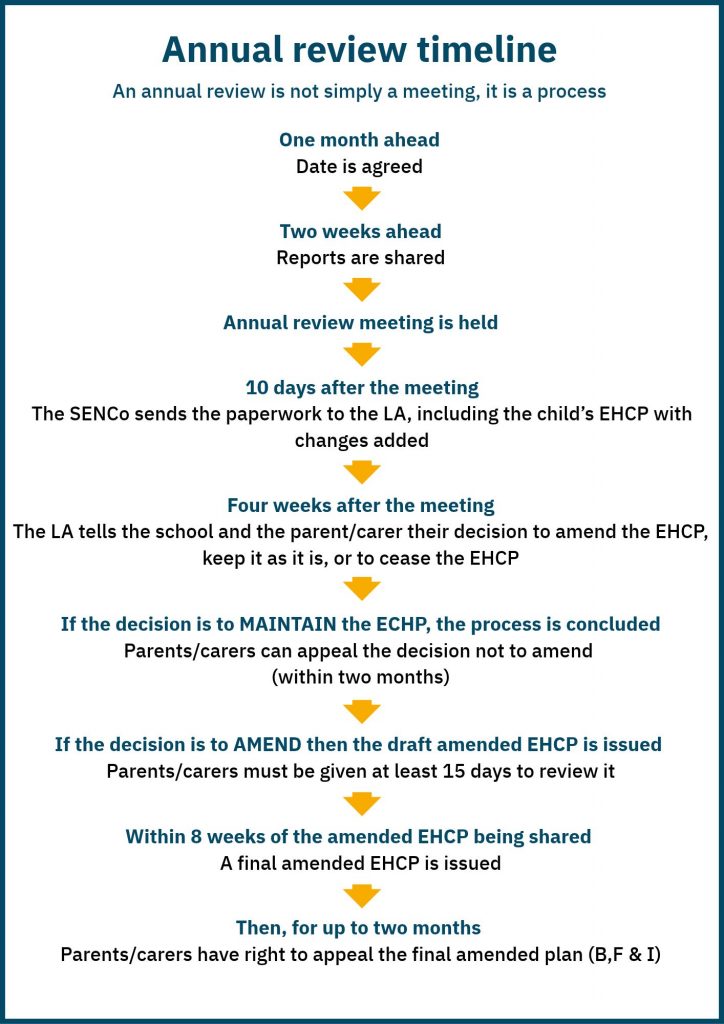
Young people’s needs do not stay the same as they progress through education. An annual review is a statutory meeting to review a child or young person’s EHCP, to ensure it is up to date and reflects their changing needs, and that the educational setting is still appropriate. Parents should be fully involved and invited to share any concerns and suggest changes. There is a process which must be followed. This process involves a meeting and concludes approximately a month from that meeting, when the local authority (LA) decides whether they are going to maintain, amend or cease the EHCP.
Who is responsible for arranging the annual review?
The local authority (LA), in Reading this is Reading Borough Council, is responsible for ensuring that the annual review takes place, but schools/early years settings/colleges are expected to organise the meeting. If the child or young person is not on roll of an educational setting, for example because they are accessing education other than at school (EOTAS), then the LA should arrange the meeting directly.
When should an annual review take place?
An annual review meeting should be held within 12 months of the previous meeting, or within six months for under 5s. Most annual review meetings are routine, but sometimes they are held early. This may be because:
- There has been significant change to the child’s needs
- The setting or the parent has concerns that the placement or provision is not appropriate and would like to discuss change of placement or provision
Sometimes annual reviews are held at very short notice, in response to an urgent situation, perhaps where there are concerns that a child is at risk of permanent exclusion.
Before the annual review
The meeting date should be agreed a month in advance, so that reports can be completed and circulated in good time.
Who should input?
It can be helpful to have input from professionals who are supporting, for example speech and language therapists (S<), educational psychologists or health professionals, particularly if needs are changing rapidly. Professional input may be particularly helpful in the run up to phase transfer, for example as children move to secondary education.
The school should get in touch with professionals who are linked to the school (eg S< or educational psychologists). You as parents may wish to contact any other professionals that your child sees outside of school, for example, paediatricians or any private therapists or professionals working with you. Some professionals may attend in person, particularly if there are pressing concerns or if it would be helpful to share information, for example, between health professionals and the school. Others may not attend but may provide a report. If your child is making steady progress, there may be no need for any professional input.
Parent views
Parents/carers should be offered a chance to express their views via a family contribution form. If you have not been able to complete this form, time should be made in the meeting to ensure that your views are captured. Reading IASS can also support you if you need help.
Child/young person views
Your child should have a chance to express their views. Often, educational settings will support with this. If your child is keen to share their views in their own way, this should be encouraged. They do not have to fill in a form. They could share a picture or record a message that you could share on their behalf. Reading IASS can also help young people and help capture their views.
Sending out reports
All reports should be shared two weeks before the meeting. This may not be possible in the case of early annual reviews.
Who should attend?
- All education, health and social care practitioners involved should be invited to the meeting (eg educational psychologist, speech and language therapist, class teacher, family support worker). However, depending on the situation, their attendance may not be necessary, and small meetings can be very effective. If a professional is actively supporting but cannot attend, they should submit a written report.
- As a minimum, the school SENCO should attend
- If there is someone who you wish to attend, for example, a private therapist working with your child, or a friend or family member, you can ask to for them to be invited or for them to submit a report
- If there are significant concerns about the suitability of the placement, the LA SEN case officer may attend
- IASS officers may be able to support you in annual review meetings, subject to availability.
Please ask us if you would like support.
At the annual review
The SENCO will usually lead the meeting. It should be a child-centred meeting and the child person should be encouraged to be present, at least for part of it. This may not be appropriate if the child is very young. This is a personal decision for the family.
The SENCO should:
- celebrate the child’s strengths and achievements and what those attending like and admire about them
- collect views on what is working well – what progress has the child made?
- collect views on what isn’t working well. For example, any new needs that have emerged and suitability of placement
- consider whether the outcomes in the EHCP remain appropriate and, if not, suggest changes (section E)
- discuss progress made towards these outcomes
- consider whether other sections of the plan remain appropriate, with particular focus on sections B and F.
If changes are needed to the EHCP, the SENCO should mark these up on an electronic version of the EHCP, to send to the SEND case officer after the meeting.
What do all the sections of the plan mean? Should they all be reviewed?
- Section A – this covers your and your child’s views, and a short history of your child’s school/medical experience and diagnoses (if appropriate). Section A gives you and your child the opportunity to formally record your views. But be mindful of spending too much time on this section in the meeting. Sections B and F are more important in terms of capturing your child’s needs and setting out their legal entitlement to support.
- Section B – strengths and difficulties – are these clear, accurate and current, and are all the needs captured? Are words like ‘significantly’ or ‘very’ needed to add emphasis. If there are difficulties listed that no longer present, these should be removed. Add in any new diagnosis information (eg autism/ADHD)
- Sections C and D – Section C describes any significant health needs your child has, and Section D any significant social care needs. For less complex situations, these sections are often blank
- Section E – This sets out the outcomes that the EHCP should help your child to achieve. You should check that these outcomes seem reasonable and offer an appropriate, medium-term time frame – usually the end of the next key stage
- Section F – This should capture all the provision that your child needs:
- If there has been new professional advice, this should be incorporated
- As well as professionals, schools can also suggest changes to the wording in section F based on their own knowledge of the child/young person
- Wherever possible, the wording in section F should be specific – ie it should detail how often, and for how long, support should be carried out. However, sometimes there is a case for flexibility in EHCPs, rather than too much prescription
- It is also important that Section F is based on the child’s needs, not what the setting says they can provide
- It can be helpful to check section F against section B: there should be provision for all the difficulties outlined in section B
- You should be able to clearly understand what support your child is entitled to.
- Section G – any health provision that does not educate or train should be in this section. Usually speech and language input would come under section F, not G
- Section H – social care provision
- Section I – placement. This should be led by the needs identified in section B, and the provision set out in section F
- Section J – covers personal budgets. These are usually only useful when a child has an unusual need requiring a service that is not provided through ordinary health or education commissioning (such as a very specific therapy need). Personal budgets can also be used when a child is not in school and is accessing education through EOTAS.
Getting the wording right in sections B and F
There is an art to getting the wording in the EHCP right. The word ‘needs’ can be confusing. For this reason, we advise you to think of section B as describing the strengths and difficulties that your child has, and section F as setting out the provision that they need.
Take these sentences, for example:
[Child’s name] experiences sensory overload in busy classrooms. He needs adult support to co-regulate so that he can stay calm.
This could be broken down in an EHCP as follows:
| Section B | Section F |
|
Strengths With adult support, [name] is able to co-regulate effectively and remain calm
Special educational needs [Name] experiences sensory overload in busy classrooms |
Adult support to co-regulate so that he can stay calm.
A sensory reduced environment
|
Can I ask to change school?
An annual review is the way in which a parent/carer can formally raise the issue of a change of placement. It is always good practice to ensure that a formal, structured discussion takes place, via the annual review process, when there are concerns about placement. It may be that there is support that could help the child/young person to be successful in their current placement. The school could request input from external advisors, such as educational psychologists, S< or OT services, or the RISE team. This could identify any support strategies that may be helpful. The school may have already sought this input before the annual review meeting. If not, you could ask for it at the annual review.
If your child’s needs cannot be met by the current provision, this should be noted on the annual review form. You may be asked for your preferred placement. If you are not sure, do contact IASS for guidance.
Can I ask for more funding for my child?
Yes, although this is really the school’s conversation to have with the LA. An annual review is an opportunity for schools to request additional funding to support a child or young person. They do this by a process called provision mapping where they set out the costs of the support needed. Remember that your child is entitled to all the provisions that Section F specifies – whatever the cost. Your child is not entitled to anything that is not set out in the EHCP.
After the annual review
The SENCO should send the formal report of the annual review, along with the marked-up EHCP (if appropriate) and any other professional reports received since the last annual review, to the LA SEN case officer within 10 working days.
The case officer should respond with the formal decision or outcome of the annual review within four weeks of the date of the meeting. They will usually do this by email. It is important to note that the annual review is not officially concluded until this decision has been received.
The LA can decide to:
- Maintain the plan – keep it the same. They will usually do this if there are not very many changes requested
- Amend the plan – amendments can be to any number of sections. They will usually do this if there are significant changes, or if the child or young person is approaching phase transfer (from primary to secondary; or secondary to post-16)
- Stop the plan – This would usually only happen when a young person has completed their education.
Amending the EHCP
If the LA decides to amend the plan, they will issue an amended draft, and you should have at least 15 days to review it, just as you did when the EHCP was first issued. You should pay particular attention to sections B and F using the advice in this document to guide you.
The LA must give you at least 15 days to review the plan, but they may take up to eight weeks to issue the final amended version.
What if the timeline is not followed?
If the LA has not notified you of the decision to amend, maintain or cease the EHCP within four weeks of the meeting, they are in breach of their statutory duty and you have a right to complain. In the first instance, we would suggest that you contact your case officer to ask about the delay.
The LA has decided to maintain, but I think the EHCP needs amending
First, talk to your case officer to find out why they decided not to amend the EHCP. You can also talk to us to discuss how important those changes are. If your child is not about to transfer between phases of education, it may be OK for the EHCP to be kept unchanged for another year. Every situation is different and it depends on the extent and importance of the changes.
If you cannot resolve the matter, you have a right to pursue formal mediation or to appeal to SEND tribunal within two months of the decision to maintain.
The LA has amended the EHCP, but I’m not happy with the changes
First, talk to your case officer to find out why they have not agreed to make the changes you wanted. You can also talk to us to discuss how important those changes are. If you cannot resolve the matter, you have a right to pursue formal mediation or to appeal to SEND tribunal over sections B and F of the EHCP within two months of issue of the final amended version.
The LA has amended the EHCP, but has not changed the school
If this is your situation, it may be best to contact us for tailored support. School placement is tied into the EHCP. You have a right of appeal for up to two months of the issue of the final amended EHCP. It is important to note that your appeal rights will expire after two months, even if there are school consultations still pending.
Phase transfer annual reviews
Phase transfer is when your child is moving from primary to secondary, or secondary to post-16 education. All annual reviews matter. But annual reviews at these times are even more important.
Secondary transfer
For secondary transfer, it is important that the EHCP is updated with particular care, so that it reflects the child’s needs accurately, so that school consultations are effective. We have a separate advice sheet on secondary transfer so please ask if this is your situation.
Preparing for adulthood
From year 9 upwards, annual reviews should consider preparing for adulthood, and the young person should be encouraged to be more involved in the process. Outcomes should be reviewed and may be rewritten with this in mind. Again, it is important that this process is effective and timely, so that consultations with post-16 settings are effective.
Where else to get help
IPSEA is an online advice service on SEND which has advice on annual reviews: https://www.ipsea.org.uk/annual-review
You may want to look at this guide to a draft EHCP created by Contact:
https://contact.org.uk/help-for-families/information-advice-services/education-learning/ehc-plans-assessments/getting-an-ehc-draft-plan/